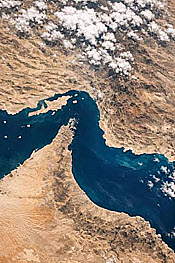
Far too many people, even some on the right side of the political aisle have a narrow view regarding the Strait of Hormuz and are far too quick to condemn Trump for “mishandling the war.”
They claim that President Trump has made the war against Iran “all about oil” and “all about the Strait of Hormuz” proclaiming over and over again that “we don’t get any oil from Hormuz, and we should have left the Hormuz situation to those that do get their oil from it.” To suggest, or believe that the U.S. doesn’t benefit from shipping through the Strait of Hormuz, or that others should have been left to deal with it because we don’t benefit from it is myopic and in some cases, hypocritical.
It’s time to set the record straight, especially for those who have complained that the war is all about oil, and everything else has been ignored.
Is it true that the U.S. does not get any of our oil from the Middle East via the Strait of Hormuz?
No. That’s a false belief. The U.S. does, in fact, still get roughly 7% of our oil from the Middle East via the Strait of Hormuz…like it or not…believe it or not. That is just a fact but it is not the only fact that matters in the equation. Asian nations like India and China rely heavily on oil from the Middle East. India is a U.S. ally, but they lack the military naval capability to keep Hormuz open and/or free of Iranian regime extortion. China is a geopolitical advisory of the U.S., and while the near-sighted would claim that we shouldn’t give a damn about China’s ability to import oil from the Middle East, China DOES have the military naval power to to control the Strait of Hormuz AND they are an ally of IRAN…so guess which side they would take in the war if we left it to them to deal with Hormuz.
Japan gets roughly 95% of their oil energy via the Strait of Hormuz and South Korea gets about 75% of their oil energy via Hormuz, but neither of those strong U.S. allies have the capability of taking on Iran’s control of that key patch of water. Europe, on the other hand, does possess the military capability necessary, but when President Trump asked for Europe to engage on their own behalf, Europe declined.
Has Trump made the war against Iran all about oil and the Strait of Hormuz?
No. Iran did that by laying mines in the Strait, by firing rockets and launching drones at ships in the Strait, and by trying to extort money from other countries whose ships were trying to get out of the Strait. Iran did that because they understand what far too many on our side willingly want to ignore…the Strait of Hormuz is economically tied to the global economy, and the last I checked, the U.S. by virtue of existing on the planet is, like it or not, part of the global economy. Iran knew that choking off shipping via the Strait of Hormuz would cause massive disruptions throughout the global economy by causing prices to rise creating a situation that could well result in a global recession which could, in turn, swing nations into taking Iran’s side in the war.
The Iranian regime publicly stated that they would not give up their leverage by standing down regarding Hormuz. That’s because the Iranian regime is desperate to control the price of oil by controlling the primary shipping lane for it.
Guess who else understands that potential pending economic disaster…President Trump…and if Western Europe wasn’t going to assist, President Trump was, and is willing to act by using the U.S. Navy and our substantial technological advantage hold the Iranian regime at bay, and accountable by turning the economic pressure the Iranian regime hoped to use against the world back against Iran itself.
Aside from oil, other energy commodities like liquefied natural gas also rely heavily on shipping via the Strait of Hormuz. In fact, on a global scale, nearly 20% of LNG comes out of the Gulf States via Hormuz and believe it or not, Iranian regime disruptions in LNG shipping have deeper and more far-reaching effects on the global economy than does the disruption of the oil trade.
It really is a supply and demand economic problem. If global supply is limited by the Iranian regime, the global demand causes the global prices to rise, not just for the energy commodities themselves, but for everything that relies on those commodities for production and manufacturing worldwide.
Why not just destroy Iran’s oil fields and why do we keep trying to “negotiate” with the death-cult regime?
Military and economic strategists and experts will rightly say that destroying the Iranian oil fields will cause an immediate, and long-term spike in global oil prices because it would take years to rebuild them, and because of the way they were constructed in the first place, suddenly stopping the production would cause the future production from those fields to be, at best, 80% of what they are capable of producing now. Less supply to the global market means greater demand, and higher long-term prices.
If Iran is seen as controlling shipping via the Strait f Hormuz, they would control the supply, demand and prices, but oil and commodity speculators suddenly calmed down as the lines of “negotiations” opened, dropping oil and other commodity prices and somewhat stabilizing them. I don’t believe the “negotiations” were, or are expected by the Trump administration to result in “peace,” rather to shine a light on the fact that the regime, despite their rhetoric, has no real or lasting leverage over Hormuz.
Is there anything outside of energy commodities that matter to the U.S. where the Strait of Hormuz is concerned?
Absolutely. Both Western Europe and North America rely on the free flow, via shipping through the Strait, for things like aluminum. Nearly 6.3 million tons of aluminum, roughly 9% of the global market overall, and roughly 23% of the global market if you take China out of the equation, comes through the Strait of Hormuz. Disrupt that, as the Iranian regime has, and the London aluminum market price last week was $3,164.20 per metric ton, UP from $2,200 per metric ton before the start of the war against Iran.
Yes, aluminum IS the most available metal on Earth, but it is also the most widely USED metal on Earth, essential for electronics, packaging, transportation, building/construction and a host of other things, making the metal crucial to the global economy.
The Gulf neighborhood also produces almost 44% of sulfur on a global scale. Sulfur has plenty of uses, but the primary use of the stuff is for the chemical fertilizer industry, which consumes almost 70% of the global supply of it. While Iran wants to crash the global economy, essentially holding the world hostage, sulfur, as utilized by the fertilizer industry is highly crucial to the production of strategic crops such as corn, soybeans and wheat.
Ask any U.S. farmer what happens to prices regarding what they’re growing in their fields all across our great nation when the supply of fertilizer fails to meet the demand necessary to grow those crops.
Sulfur however, is necessary for lots of things other than just fertilizer. The semiconductor and electronics sectors require substantial quantities of high-purity sulfuric acid related to microchip production and silicon wafer processing and any shortage due to supply issues created by the Iranian regime increases manufacturing costs in major East Asian tech hubs—including Taiwan, South Korea and China. But there are plenty of other important reasons the Iranian regime, NOT President Trump, has made Hormuz the battleground with regard to sulfur and key global economics.
The medical field also relies heavily on sulfur. Therapeutically, sulfur it is used for dermatology, pharmacology, and chronic disease management. Sulfur is used widely used for its antibacterial, antifungal, and keratolytic properties to treat many conditions. Various sulfur compounds are used to help the liver neutralize toxins, manage medication side effects (e.g., acetaminophen), and process hormones. In fact, many of the most essential medications utilize sulfur derivatives in the treatment of afflictions like osteoarthritis and joint pain.
The disruptions in supply of the aforementioned commodities caused by the Iranian regime spiked prices including in the U.S., but President Trump’s mitigation of the regime’s efforts to crash the world economy both stabilized and/or lowered, a lot of those prices. One should be able to see how important Hormuz actually is, even though we only get 7% of OUR oil from that region, but any who complained about rising prices whether at the pump or at the grocery over the past 4 months and blamed it on President Trump while ignoring Iran’s role in trying to crash the global economy, are somewhat hypocritical.
Now, of course, those same people will, or are blaming Trump for not going full throttle against Iran militarily from the very beginning, but again, that line of thought is, I believe, myopic.
No war is easy, cut and dried or happens in a strictly black and white world. Had we gone full throttle, which would have included ground troops from both the U.S. and Israel from the jump, there is a good chance that the number of Iranian people seeking to flee as refugees would have been staggering, and that sort of rush toward anywhere but Iran would also have made it impossible to vet or clear said “refugees” to strain out IRGC islamists, and nobody in the region wants to risk intaking terrorist sleeper cells. Proof of that sort of situation is no further back in history that the chaos that occurred because of Biden’s surrender in Afghanistan.
To be clear regarding the Iranian Freedom Fighters, exiled Iranian Crown Prince, Reza Pahlavi, in March, instructed the Freedom Fighters to await his final call to leave their home, take to the streets and topple what’s left of the regime. Pahlavi knows that IRGC checkpoints are death-traps for those within Iran who seek freedom.
That said, I believe there’s been a huge shift within the Iranian regime itself. I think the pause, or MOU (Memorandum of Uncertainty) intermission, which I initially believed to be ill-advised, may well have exposed the new power structure in Iran…away from their invisible new Supreme Leader, and more towards militaristic control in the hands of the IRGC…away from a strictly theocratic ideology and more toward a heavily militaristic model.
That’s important because military-centered regimes can be much more easily brought down by greater military might than can radical theocratic regimes, and it also is much more palatable to the Arab States. Not only that, but while many are steadfast in the belief that the MOU pause was only beneficial to the Iranian regime, the new control arm of Iran, the IRGC, exposed themselves and many of their hidden facilities which, over the past week, have been targeted and destroyed.
Witkoff and Kushner were in over their heads in my opinion, and should be relegated back to making deals of economic value rather than chasing their tails against a radical islamist regime. Between President Trump, and Prime Minister Netanyahu…between the CIA and Mossad…between the IDF and our own great and powerful military, and with Rubio, Hegseth and Raisin’ Kain, and Admiral Bradley Cooper, if we’re smart, careful, strategically deliberate and avoid the brute-force mistakes of past efforts at regime change, this will end well.
In a nod to Shakespear, “Cry ‘Havoc,’ and let slip the dogs of war.”
Copyright © 2026 Craig Andresen / thenationalpatriot.com all rights reserved
************************************************************************************************************
For more political commentary please visit my RIGHT SIDE PATRIOTS partner Diane Sori’s latest Op-Ed at The Patriot Factor, On Blockades, Turkey, and the Economics of War.
************************************************************************************************************
RIGHT SIDE PATRIOTS…LIVE!
Tomorrow, Tuesday, July 21st. from 7 to 8:30pm EST, RIGHT SIDE PATRIOTS Craig Andresen and Diane Sori discuss ‘‘On Blockades, Turkey, and the Economics of War‘’; and important news of the day. Tune in to RIGHT SIDE PATRIOTS on https://rspradio1.com Click ‘LISTEN LIVE.’